The Eucharistic Miracle of Bolsena: A Divine Answer to Doubt and a Witness to the Real Presence
Introduction
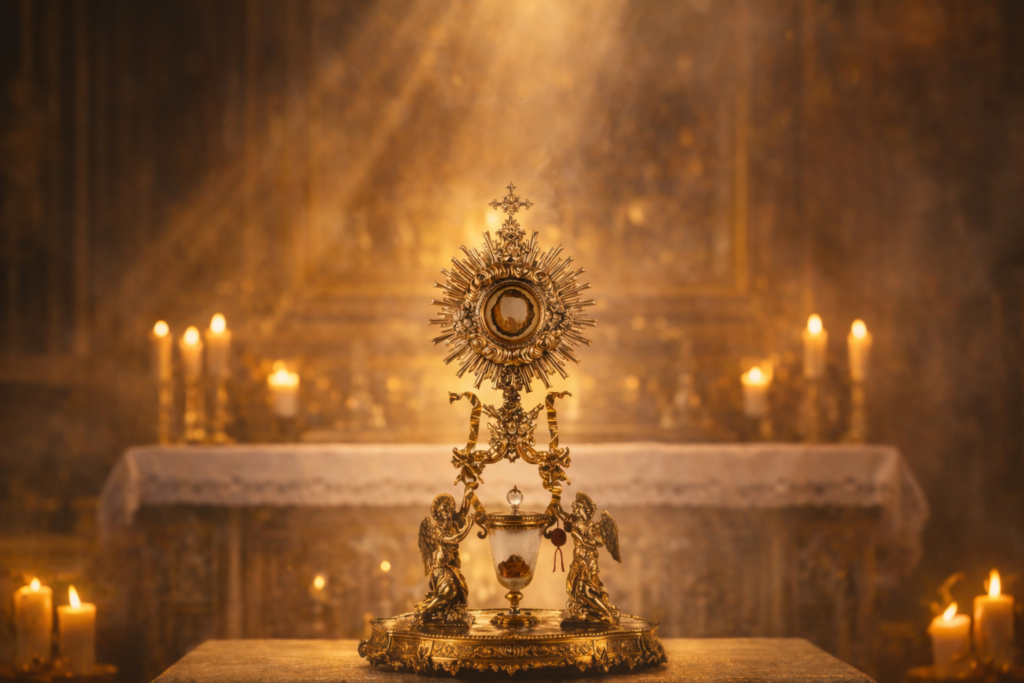
In 1263, in the town of Bolsena, a priest’s hidden doubt became the occasion for one of the most powerful Eucharistic miracles in Church history. The Eucharistic Miracle of Bolsena stands as a visible sign of an invisible truth:
👉 The bread and wine truly become the Body and Blood of Christ.
This truth is not merely devotional—it is defined doctrine, rooted in Scripture, affirmed by Tradition, and taught authoritatively by the Church.
This miracle powerfully confirms the Church’s teaching on the Why Catholics Believe in Real Presence.
Historical Account of the Miracle
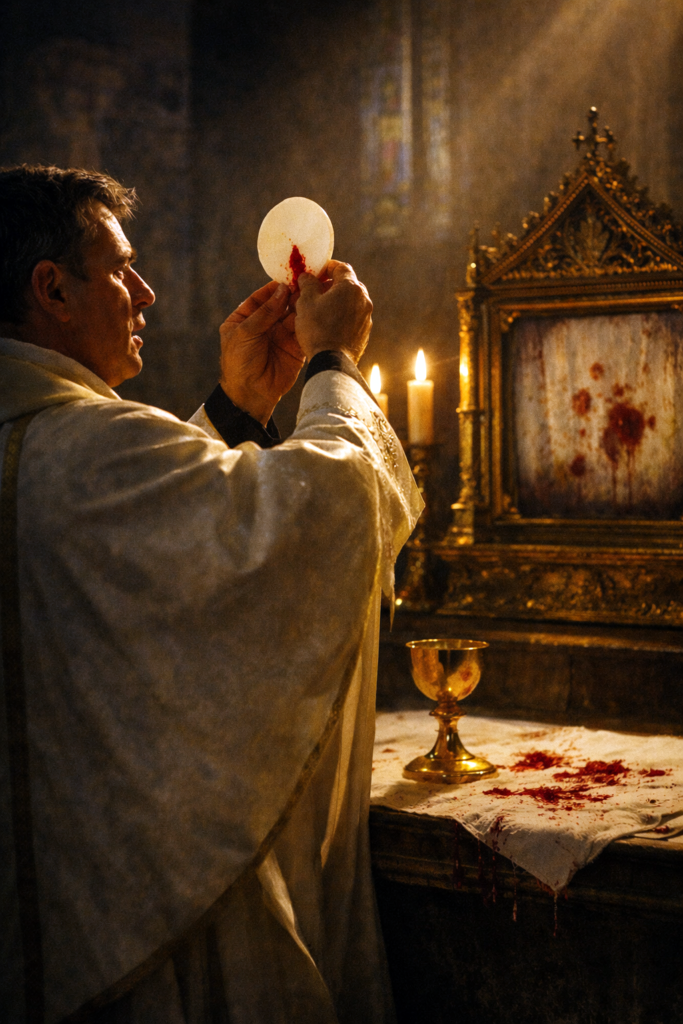
The event is traditionally associated with Peter of Prague, a German priest struggling with doubts about the Real Presence.
While celebrating Mass at the Church of St. Christina:
- After the words of consecration, the Host began to bleed
- Blood stained the corporal and altar
- The priest, shaken, halted the Mass
He reported the incident to Pope Urban IV, who was residing in Orvieto.
Following investigation, the miracle was approved, and the sacred corporal was transferred to the Orvieto Cathedral, where it is still venerated today.
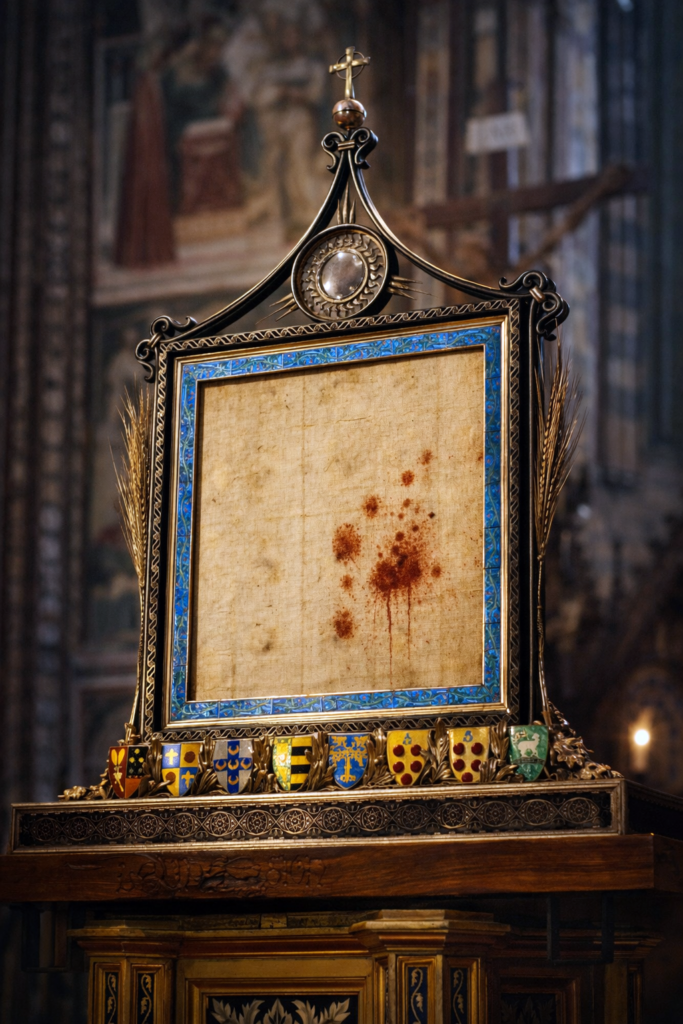
The Eucharistic Miracle of Bolsena is one among several recognized miracles in the Church, including the well-known Eucharistic Miracle of Lanciano.
Biblical Foundation (RSV-CE)
The miracle does not introduce a new belief—it confirms what Christ Himself revealed.
At the Last Supper:
“This is my body which is given for you. Do this in remembrance of me.”
— Luke 22:19 (RSV-CE)
“This cup which is poured out for you is the new covenant in my blood.”
— Luke 22:20 (RSV-CE)
In the Bread of Life discourse:
“For my flesh is food indeed, and my blood is drink indeed.”
— John 6:55 (RSV-CE)
St. Paul warns:
“Whoever… eats the bread or drinks the cup of the Lord in an unworthy manner will be guilty of profaning the body and blood of the Lord.”
— 1 Corinthians 11:27 (RSV-CE)
These passages form the Scriptural backbone of Eucharistic doctrine—clearly affirming that the Eucharist is not symbolic.
This transformation, known as Transubstantiation, is central to Catholic Eucharistic theology.
Doctrinal Teaching of the Church (CCC)
The Church formally teaches this mystery as Transubstantiation:
“By the consecration… there takes place a change of the whole substance of the bread into the substance of the body of Christ… This change the holy Catholic Church has fittingly and properly called transubstantiation.”
— Catechism of the Catholic Church 1376
Further:
“In the most blessed sacrament of the Eucharist ‘the body and blood… of our Lord Jesus Christ… is truly, really, and substantially contained.’”
— Catechism of the Catholic Church 1374
And:
“The Eucharist is ‘the source and summit of the Christian life.“
— Catechism of the Catholic Church 1324
The Bolsena miracle visually reinforces what the Church already definitively teaches.
Liturgical and Ecclesial Impact
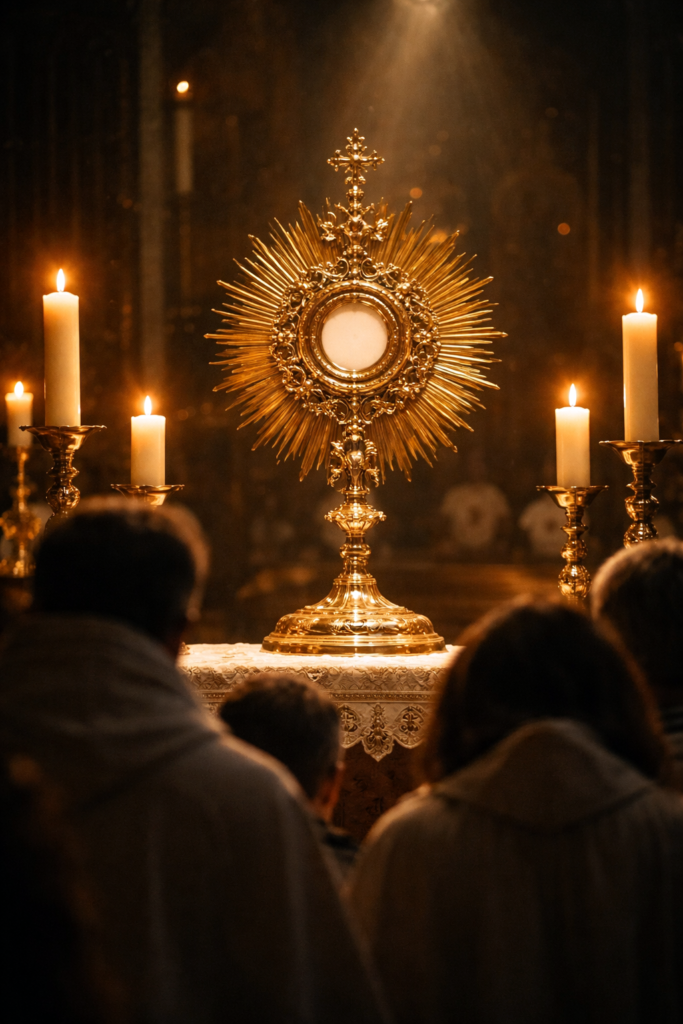
Deeply moved by the miracle, Pope Urban IV instituted the universal feast of:
👉 Feast of Corpus Christi
To enrich this feast, he entrusted Thomas Aquinas to compose Eucharistic hymns, including:
- Pange Lingua Gloriosi
- Tantum Ergo Sacramentum
These hymns remain central to Eucharistic adoration worldwide.
The institution of Corpus Christi also deepened the Church’s devotion to Eucharistic worship, especially through Eucharistic Adoration.
Canonical and Liturgical Reverence
The Church safeguards the Eucharist with strict reverence in Canon Law:
“The Most Holy Eucharist must be reserved in a… secure tabernacle.”
— Code of Canon Law Canon 938
“Sacred hosts… are to be renewed frequently.”
— Code of Canon Law Canon 939
These laws reflect the Church’s unwavering belief:
👉 This is not ordinary bread—it is Christ Himself.
These laws reflect the Church’s belief, clearly seen in the Eucharistic Miracle of Bolsena:
Theological Reflection
The Eucharistic Miracle of Bolsena teaches three essential truths:
1. Faith and Reason Are Not Opposed
The priest doubted—but God responded with visible grace, not rejection.
2. The Eucharist Is Objective Reality
The transformation does not depend on belief—it is real because Christ said so.
3. Miracles Point Beyond Themselves
The goal is not fascination, but deeper worship and conversion.
Why is the Eucharistic Miracle of Bolsena Important?
The Eucharistic Miracle of Bolsena is important because it visibly confirmed the doctrine of the Real Presence, strengthening faith and leading to the institution of the Feast of Corpus Christi.
FAQ (Frequently Asked Questions About the Eucharistic Miracle of Bolsena)
1. What is the Eucharistic Miracle of Bolsena?
A 1263 miracle where a consecrated Host bled during Mass, confirming the Real Presence.
2. Is the Eucharistic Miracle of Bolsena officially recognized by the Church?
Yes, it was investigated and approved under Pope Urban IV.
3. Where is the relic of the Eucharistic Miracle of Bolsena kept today?
In Orvieto Cathedral, Italy.
4. What doctrine does the Eucharistic Miracle of Bolsena support?
The doctrine of Transubstantiation (CCC 1374–1376).
5. Did the Eucharistic Miracle of Bolsena influence any Church feast?
Yes, it led to the universal celebration of the Feast of Corpus Christi.
6. Are Eucharistic miracles necessary for faith?
No. Faith is based on Christ’s Word, but miracles strengthen belief.
The Eucharistic Miracle of Bolsena remains one of the most powerful signs of Christ’s Real Presence in the Eucharist.
Conclusion
The Eucharistic Miracle of Bolsena is not merely a historical event—it is a theological sign pointing to the heart of the Catholic faith.
When doubt arises, this miracle echoes Christ’s own words:
👉 “This is my body.”
The question is no longer whether He is present—
but whether we are ready to believe, adore, and receive Him worthily.
The Eucharistic Miracle of Bolsena continues to inspire faith in the Real Presence of Christ.
Sources & Resources
Scripture (RSV-CE)
- Luke 22:19–20
- John 6:51–58
- 1 Corinthians 11:23–29
Church Documents
- Catechism of the Catholic Church (CCC 1324, 1374–1377)
- Code of Canon Law (Canons 934–944)
Vatican / Official References
- Vatican archives on Eucharistic devotion (see Holy See resources at vatican.va)
- Papal institution of Corpus Christi by Pope Urban IV
Historical & Devotional Sources
- Orvieto Cathedral official records
- Tradition of the Church regarding Peter of Prague
The Eucharistic Miracle of Bolsena is part of a larger tradition of miracles that strengthen faith. Explore more on our Eucharistic Miracles page.